Monday, November 29, 2004

Eavesdropping on the Cockpit Isn't Always a Good Thing

One of the unique things about United airlines is that they allow passengers to listen in on the cockpit radio through the plane's audio system, allowing people to hear the conversation between air traffic controllers and their pilots, as well as any other planes that are on the same frequency.

While maybe not a big deal to people who fly for leisure, for most of us this is the only time we hear actual air traffic controllers (not counting the ones on TV who whined that they were fired by Reagan in '81).

I usually find listening in a good form of entertainment. On my trip over Thanksgiving, I made the following observations:
o The movie Pushing Tin wasn't great, but Thorton and Cusack must have watched real controllers in action since they had their rhythm down cold. It's not just the jargon they use, but how they say it, the speed they say it, and the inflection they say it. All of the controllers seem to talk in the same way.

o Despite the similarity in rhythm, a few controllers seem to have their own signature "sign-off" as they pass a plane off to another controller. One guy out of Ft. Worth control passed planes off with a SEE YA! A few others had a standard greeting whenever a new plane was passed into their control.

o Part of the entertainment value of listening in is to figure out graphically in your head where everyone is by altitude and position. In addition, for us novices, it was intriguing to figure out the jargon.
Pilot: Anyone seen Charlie?
I wondered why he would ask about another pilot or controller, but a few moments into the conversation I figured out he was asking about "chop".
That being said, there were a few things that weren't so fun to listen in on:
o The pilot of my plane literally took a wrong turn at the airport. He and the ground controller went back and forth several times about where he was supposed to go for take-off, but he still missed his turn. He had to taxi all the way to the end of the airport and turn around, and then taxi back and do a u-turn in the middle of the runway. This didn't exactly increase my confidence in his ability to fly.

o I got real nervous as we were flying into Denver, where we were connecting. Denver is one of United's hubs, so there are a lot of United planes coming in, and some genius in operations gave two planes coming in at the same time a flight number that differed by a single digit. I got to hear a conversation that went something like this:
Pilot: United 247 contacting control
Controller: Gooday United 247. Note that United 347 is also on the same frequency.
...Later
Controller: United 247 change speed to 220.
Another Pilot: United 347?
Controller: That was United 247.
Pilot: Speed 220. United 247.
...Later
Controller: United 247 change to approach on frequency xxx.
(garbled radio)
Pilot: United 347 just took my frequency!
Another Pilot: United 347 is still here.
Pilot: Frequency xxx, United 247.
o Another time it didn't take a similar number to screw up a pilot. I was listening to a controller talking to three planes when another pilot rang on, but never got a response from the controller, and there was suddenly some confusion.
Controller: Flights 247, 384 Heavy, 7763 clear your radios. Who is this?
Another Pilot: Flight zzz checking in.
Controller: YOU ARE ON THE WRONG FREQUENCY! Dial into xxx.x!
Another Pilot: xxx.x, Flight zzz
Note that these events were all pilot errors, so I have to give credit to the air traffic controllers, who have an incredibly stressful job.

So while flight control might be interesting to listen to, small errors like these are inevitable in the system we have, so maybe listening to the radio might be the way to go.
Saturday, November 20, 2004

It's That Time of Year

The leaves are changing. It's a bit cold in the air. Thoughts are turning to loved ones far away, Thanksgiving dinner, Christmas shopping. All this means that it's time for the 2005 planning cycle and financial forecast.

There is something perverse about how the biggest business rush of the year coincides at the time that people are a little more focused on family (or if you are more cynical, you could say it coincides with the biggest consumer rush of the year). And in 15 years of business at multiple companies I have found that the process is always the same.

As Thanksgiving bears down on companies, panicked messages will go out to create the first draft of the '05 plan before people start leaving for Thanksgiving vacation. That deadline will be missed and conference calls will be held with people who are on the road with their families. People will call in from the back studies of their parents or grandparents house.

The first week of December the first draft will be completed. Multiple meetings will be held where debates and arguments will rage. Analysts and product specialists with detailed information on the market will be told by executives with no segment experience that their forecasts are wrong and will finally just give them the number the forecasts should hit. A rush will be on to get the final results completed by mid-December, when people start trickling out of the office for their Christmas break. A few people will send last minute revisions and updates from the road. At least one person on the last conference call before completion will dial in from a ski resort. By the time New Years comes along a thick document will be produced that has the company's roadmap for the next 12 months. A secretary who has been with the company for decades will be asked to come in New Years eve to print and distribute the final drafts.

And by the time Groundhog Day comes along all that work will be tossed out the window and forgotten as the assumptions that were made for the next 12 months will have already been proven wrong.

Thursday, November 18, 2004

How to Say No and Keep the Account

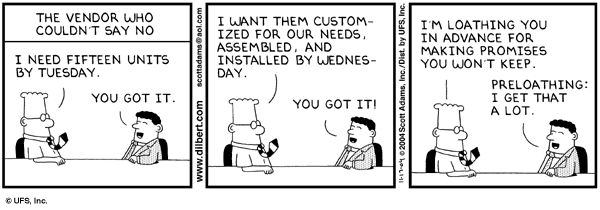
This is definitely not me:

In my dealings with customers I am honest about what they can and can't get, although I use more diplomatic methods than Just Say No:
o The Japanese Sigh - You do a sharp intake of breath from the corners of your mouth and exhale, saying "That would be very difficult..." In Japan, this means "No #$%&ing way." Most people outside of Japan also get the hint.

o Lie to Tell The Truth - This requires you to tell one lie so you can tell the customer the truth without pissing him off. For example, I had two customers come in with urgent design requests at the same time. I had to give the design team to the more important customer, so the other customer had to cool their heels for a week. I wasn't going to lie and say their design would be ready in a week, and I didn't want to tell them that they got bumped for another customer. So I made up an Asian holiday, Buddha's Harvest Moon Festival, ("It's sort of like their Thanksgiving"), and said the design team was out for a week visiting their ancestral homes. Being culturally attuned, the customer moved his request out a week. Everyone was happy.

o I'll Get Back To You On That - And then don't. Yeah, it's an old trick, and only works in certain circumstances (mainly existing customers who have high switching costs). Is this better or worse than setting unrealistic expectations? Your call.

o What the President/CEO/Chairman Really Meant Was... - This is cleaning up after a higher-up pulled what the vendor did in the Dilbert strip. You can't go in and say "no" after the CEO promised it, so it is a delicate dance of re-interpreting the execu-speak that had been uttered by the upper echelon. It usually works, maybe because customers also have CEOs who do the exact same thing to them.

o Roll the #@$* Downhill - This goes something along the lines of "Look, my factory is ready to go and we have no problems. The problem is that the lead-times of your raw materials are pushing out the schedule." This basically just shifts the blame on someone else further down the supply chain while you scramble to get your factory up and running. This tactic is particularly useful if your customer doesn't know the real leadtimes of his raw materials.
The bottom line is that I give my customers the truth on when they'll get their product and what they can get - I just might lie as to the reason why.

Wednesday, November 17, 2004

Sears-Mart? K-Sears? K-Smart?

Wow, this was a surprise: Kmart Buying Sears

I am witnessing the slow breakup of retail companies from my youth: Woolworth, Montgomery Ward, and now Sears.

It's not unlike watching movies stars you grew up with start dying away.

Friday, November 12, 2004