 Cigar Review: Ashton Classic Esquire
Enjoyed an Ashton after a home-cooked steak on my coal-fired grill (pissing off both environmentalists and animal rights activists at the same time). I had a Ashton Classic Esquire, one of two I received as stocking stuffers this last Christmas. The cigar had a rich, smooth, pleasant taste, but it did have a bit of an after-taste which detracted from the experience, knocking some points off its rating. It also had an uneven burn, which I find annoying, but isn't always the fault of the producer since it could be caused by improper storage (I have a proper humidor which I check regularly, but I wouldn't call myself a storage expert).
Overall, a very good cigar: four out of five stars, or keeping with my 100 point scoring system I used when I started these reviews, 83 out of 100. Ashton markets themself as Pleasure Beyond Expectation, and I think they produce a very good cigar, but not the top of the line.

Window Manager - A (Now Retired) Executive Who has Nothing to do but Look out the Window
Sunday, March 21, 2004
Wednesday, March 17, 2004
Consumer Review: Netflix
Thumbs up! I have been thinking about signing up Neflix for half a year now and finally did it after wandering into my local Blockbuster and finding absolutely nothing to rent (never mind the fact that I pay $15 a month for HBO and except for the Sopranos, they never seem to have anything on).
For those of you not familiar with them, Netflix is a video rental company (DVD only) that operates through the internet and mail. You sign up over the internet for the movies you want to watch and they mail you the first three in your queue (you can also sign up for an 8 video package). You keep the movies as long as you want - a week, a month, whatever. When you are done with a movie, you send it back in the pre-paid envelope and they mail you the next movie on your queue.
You can watch any number of movies you want for a flat fee of $20 a month, so if you rent more than five movies a month from Blockbuster, you are in the money. In only my first week I have already received my sixth movie. The mail times are great (for me, at least). It took one day from the time I signed up until I received my first movies, and it is a two day turn from the time I return a movie until I get the next one in my queue (one day for them to get, one day for me to receive).
Another nice feature of Netflix is their browsing and recommendation software. Similar to Amazon, you rate the movies you have seen and they will suggest titles based on your selections. It's fun to sit down for a few minutes at a time and rate movies - I have done it for 500 titles so far, and I really don't consider myself a serious movie watcher.
The one unknown is the availability of "hot" new releases, but with my queue of over a dozen movies and growing, I won't mind if it takes a few extra days to get a new release versus dealing with Blockbuster. One nice feature I am looking forward to is getting a few movies to take with me for long business trips. With no late fee, I can take them with me and watch on the plane, hotel room, etc. on my DVD playing laptop and just mail them back when I get home.
Netflix's business model is being copied by several others, including Walmart, and there are indications that even Blockbuster will do something similar, so I think they hit on something here.
Update: I took a look into their stock since I liked their service, but with a PE of 341 and a business model that can be copied, I'll cheer from the sidelines.
Monday, March 15, 2004
Some Outsourcing Data You Won't See Get Much Play
The WSJ reports (link requires paid subscription) that more jobs are outsourced TO the U.S. than are outsourced FROM the U.S. Long story short, the U.S. has a net "inflow" of $53.6 billion outsourcing jobs ($131 billion sent to the U.S. for outsourcing work versus $77.4 billion outbound). In addition:
- The U.S. inbound (more jobs here) number is up $8.4 billion from 2002 to 2003.
- The U.S. outbound (exported jobs) is up $8 billion from 2002 to 2003.
So the increase in 2002 outsourcing from the U.S was more than matched by outsourcing to the U.S.
I don't think outsourcing jobs is a good thing, and I think some companies are doing it without looking at all the financial numbers or project issues (Dell has reversed some outsourcing as has some software companies). But the bottom line is outsourcing is the decision of companies, not the government. If you listen to politicians, you won't get the whole story. You'll hear sad stories about software people or call center people who lost their jobs, but you won't hear the fact that limiting outbound outsourcing will result in retaliatory measures from other countries that will hurt more Americans than it will help.
The people clamoring for outsourcing laws are of course the people most affected by it. And they have no compunction if more people lose their jobs, as long as they get in or stay in theirs. I am not blaming them - it's human nature. But if the job of the economy is to provide the most economic benefits to the most number of people, then laws limiting outsourcing are not the way to go.
Sopranos Episode 2: Booooring
Okay, maybe they're still setting up the plot lines, but I practically fell asleep in tonight's episode. Yeah, there are some questions like: is Tony's cousin Tony really going legit after getting out of prison, or is this some set-up? Are the feds finally going to get some dirt on Tony?
As the final season of Sopranos, bets are that Tony gets wacked - how better to end a series on a mobster? So all the plot lines on the fed crackdowns seem like a red herring to me.
As the final season of Sopranos, bets are that Tony gets wacked - how better to end a series on a mobster? So all the plot lines on the fed crackdowns seem like a red herring to me.
Wednesday, March 10, 2004
We Work For Little Pieces of Paper
Just Procrastinating links to a story of a woman who tried to spend a “million dollar bill” at Wallmart. Lots of people have seen these novelty items in the store and it surprises me that someone was stupid enough to try to pass one off as real currency (but isn’t there a saying about never underestimating the stupidity of the American people?).
The only difference between her novelty item and a real bill (besides the technical aspects of the type of paper and printing method) is the fact that our government says a $20 bill is “money”. That’s it: it’s money since the government says it is (fiat currency). If you think about it, it’s a little strange – we work for and then buy all sorts of goods and services by passing these little pieces of paper around. And more recently, all this is done virtually with bits of data being transferred between banks, credit unions, credit card companies and the like with no paper at all.
The evolution of money is an interesting topic and one of the reasons I got into collecting obsolete U.S. currency. Besides the historical and economic history in old currency, many of the old bills are like little pieces of art compared to the monopoly money our government is churning out today.
I am what is called a “type” collector. Once I get a type of currency I move on to the next note (other people collect series, serial numbers, portaits, signatures, the list is nearly endless). For example, here are just a few of the types of small-size $1 notes issued since 1928 (all from my collection):
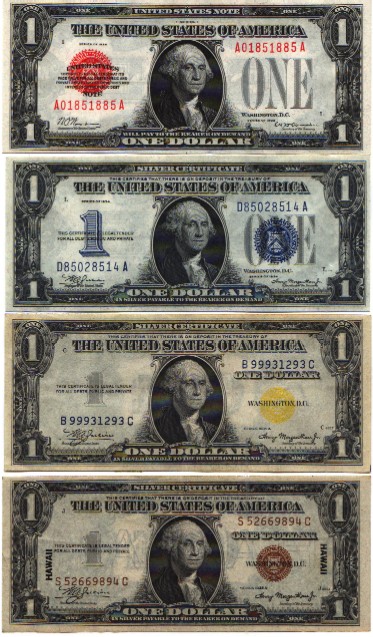
Note that this small slice of my collection contains silver certificates and a U.S. note. Other types of money that have been issued include gold certificates, national bank notes, federal reserve bank notes (FRBN), and most recently federal reserve notes (FRN). This is another interesting aspect of collecting, which is understanding the different schemes the government has tried to create money.
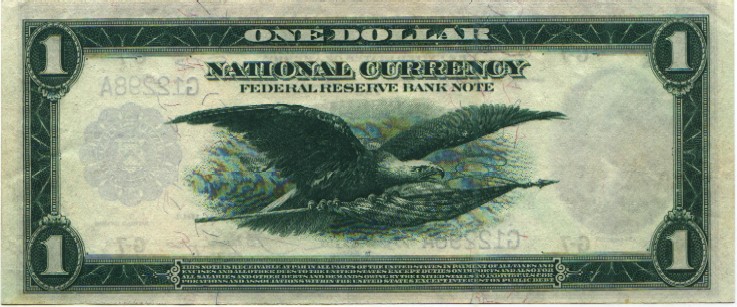
Besides types of notes, U.S. currency can be broadly divided into “large size” and “small size” notes, the small size notes being the size of the notes in your wallet, which started being issued in 1928 as a way to save money on printing costs. Large size notes tend to be more expensive due to their age, but are also the most beautiful, interesting and rarest notes in the hobby since the larger size gave the engraver more space to show his craft, as shown by this obverse of the 1914 $1 Federal Reserve Bank Note (FRBN) in my collection:
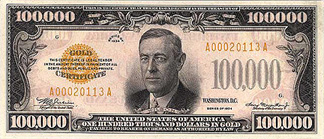
And for that woman? She should have known that the largest bill ever printed by the U.S. government was $100,000, but was used only for internal transfers between the federal banks and never put (and illegal to posses) in private circulaiton
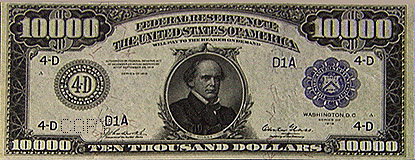
The largest bill ever printed for general circulation was $10,000, and although ALL U.S. currency ever issued is redeemable at face value at your nearest bank, this bill would fetch well into the six figures in a private sale (most known examples are in museums).
The largest "current" bill in circulation is $100, so if you see anything larger than this it is either a phony or worth a lot more than its face value as a collector's item ($1000 bills are still out there and worth anywhere from $1200 up, so don't spend them as cash).
The only difference between her novelty item and a real bill (besides the technical aspects of the type of paper and printing method) is the fact that our government says a $20 bill is “money”. That’s it: it’s money since the government says it is (fiat currency). If you think about it, it’s a little strange – we work for and then buy all sorts of goods and services by passing these little pieces of paper around. And more recently, all this is done virtually with bits of data being transferred between banks, credit unions, credit card companies and the like with no paper at all.
The evolution of money is an interesting topic and one of the reasons I got into collecting obsolete U.S. currency. Besides the historical and economic history in old currency, many of the old bills are like little pieces of art compared to the monopoly money our government is churning out today.
I am what is called a “type” collector. Once I get a type of currency I move on to the next note (other people collect series, serial numbers, portaits, signatures, the list is nearly endless). For example, here are just a few of the types of small-size $1 notes issued since 1928 (all from my collection):
Note that this small slice of my collection contains silver certificates and a U.S. note. Other types of money that have been issued include gold certificates, national bank notes, federal reserve bank notes (FRBN), and most recently federal reserve notes (FRN). This is another interesting aspect of collecting, which is understanding the different schemes the government has tried to create money.
Besides types of notes, U.S. currency can be broadly divided into “large size” and “small size” notes, the small size notes being the size of the notes in your wallet, which started being issued in 1928 as a way to save money on printing costs. Large size notes tend to be more expensive due to their age, but are also the most beautiful, interesting and rarest notes in the hobby since the larger size gave the engraver more space to show his craft, as shown by this obverse of the 1914 $1 Federal Reserve Bank Note (FRBN) in my collection:
And for that woman? She should have known that the largest bill ever printed by the U.S. government was $100,000, but was used only for internal transfers between the federal banks and never put (and illegal to posses) in private circulaiton
The largest bill ever printed for general circulation was $10,000, and although ALL U.S. currency ever issued is redeemable at face value at your nearest bank, this bill would fetch well into the six figures in a private sale (most known examples are in museums).
The largest "current" bill in circulation is $100, so if you see anything larger than this it is either a phony or worth a lot more than its face value as a collector's item ($1000 bills are still out there and worth anywhere from $1200 up, so don't spend them as cash).
Subscribe to:
Posts (Atom)